Key facts at a glance
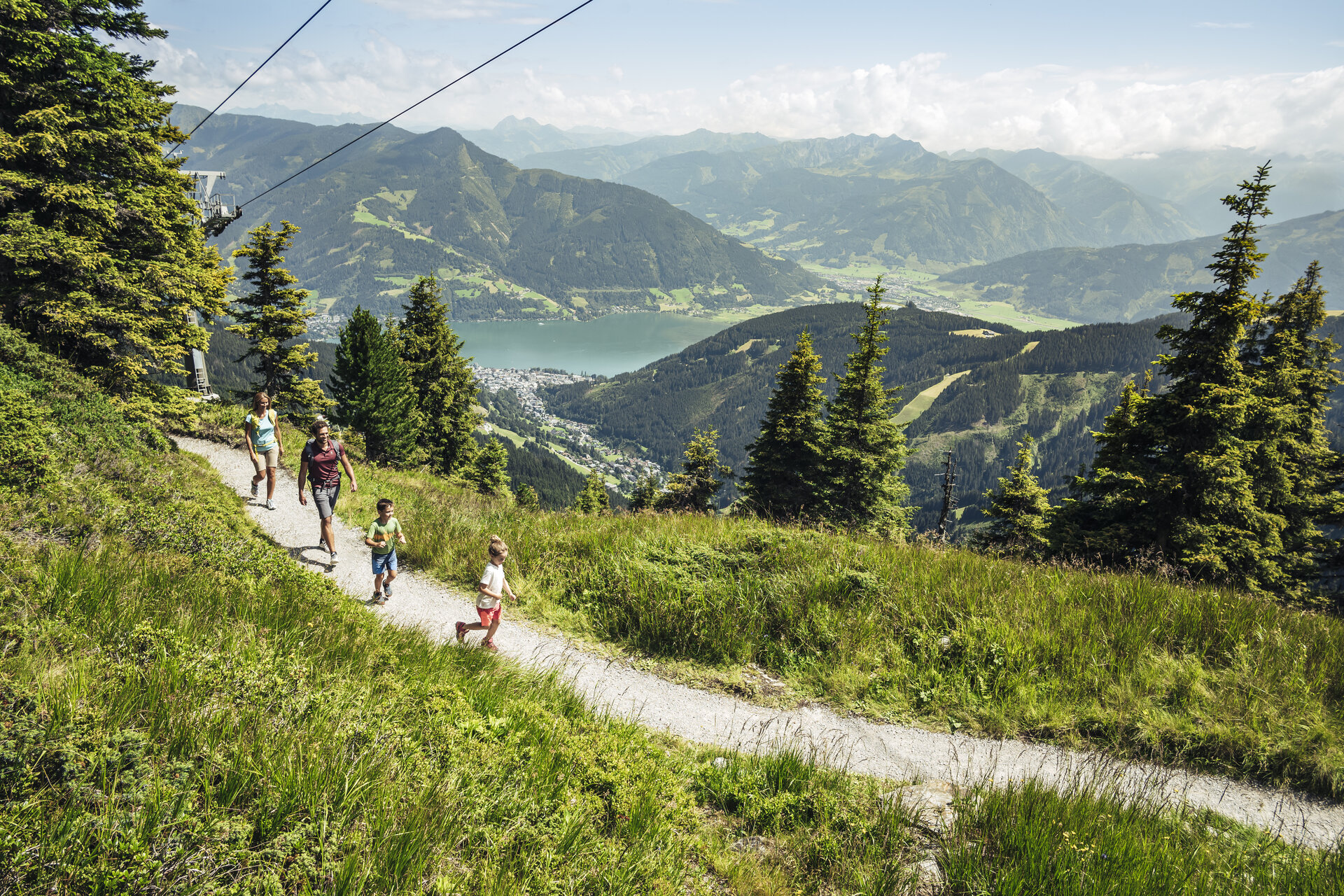
Easy routes on the Schmitten mean: take the lift up, walk at 1,350 to 1,965 m, broad paths, little climbing, but often a lot of height loss. The summit circuit (1.5 km, 30 to 45 min) and the pasture circuit at the Sonnenalm are family-friendly, in places even with a pushchair. Anything with more than 300 metres of descent is better left to the lift.
Easy walks on the Schmitten plateau mean: ride up with the lift, walk between roughly 1,350 and 1,965 metres, broad paths, little climbing, but almost always height loss on the way down. That is exactly what beginners and families underestimate. The seven routes below are all manageable without mountain experience, take between 30 minutes and a good two hours of pure walking time, and can be planned so that the lift handles the descent too. All figures are rounded guide values, so please cross-check them against the Schmittenhöhe lift company’s panorama map, because individual paths get rerouted depending on pasture operations, construction or snow.
First: what “easy” really means on the Schmitten
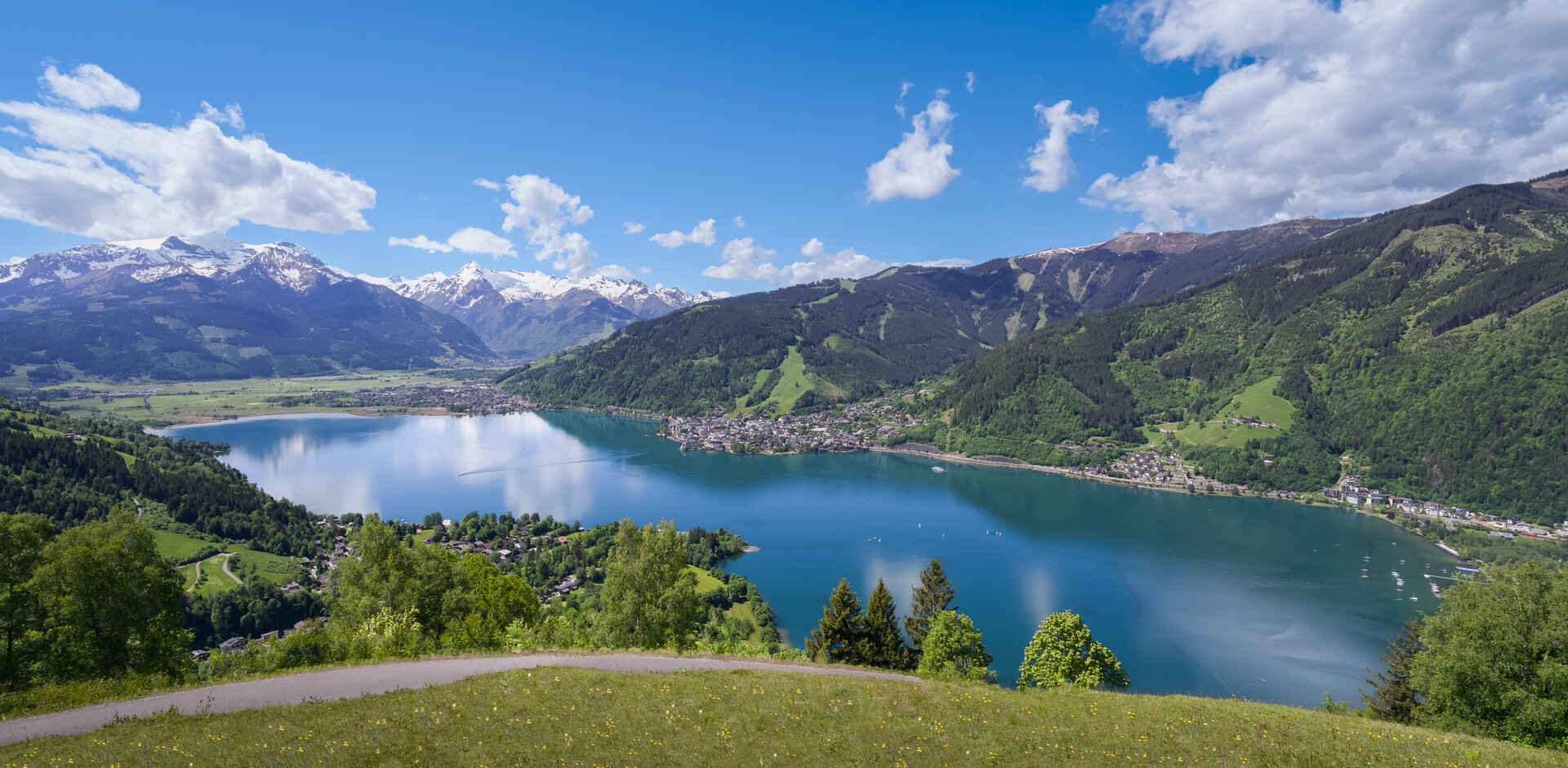
In the Alps “easy” is a statement about path condition, not about effort. A path counts as easy if it is broad, well marked and not exposed to falls. It may still lead 500 metres downhill. The Schmitten is a prime example: from the summit at 1,965 m it drops to Lake Zell at 750 m, a difference of over 1,200 metres spread across several lift sections.
The useful rule of thumb for the region: if you are out with children under eight, plan a maximum of 300 metres of descent at a stretch. The same applies if you have knee problems. Anything beyond that is not a question of fitness but of joints. A wider regional overview is in the article hiking in Zell am See-Kaprun, and the mountain portrait itself is under Schmittenhöhe Zell am See.
The seven easy routes on the Schmitten plateau
1. Schmittenhöhe summit circuit, the entry point for everyone
Around 1.5 km, about 40 metres of height gain and loss, 30 to 45 minutes of pure walking time. A broad, compacted gravel path around the summit plateau, passing the Elisabeth Chapel. Lift for the ascent and the descent. The only route here that practically anyone can manage, including with a pushchair if you skip the last steps to the chapel.
2. High-level path Schmittenhöhe to Sonnkogel
Around 3.5 km, about 60 metres up and 180 down, 1 to 1.5 hours. A firm mountain path with roots and stones, no exposed sections. Ride up with the Schmittenhöhe lift and down with the Sonnkogel lift, so the big descent is left to the lift. Not suitable for a pushchair, ideal for a carrier. This is also the finest viewpoint stage: in clear conditions the view stretches across the Hohe Tauern to the Kitzsteinhorn with the Gipfelwelt 3000 at 3,029 m.
3. Sonnkogel to Sonnenalm: the descent exercise
Around 2.5 km, about 500 metres purely downhill, 1 to 1.5 hours. Marked “easy” on the map, but in practice the route where children start complaining and knees make themselves heard. Only do it if the group is used to descents. Otherwise: take the Sonnkogel lift.
4. Schmittenhöhe to the Pinzgauer Huette and back
Around 5 km there and back, about 250 metres down and the same back up, a good 2 hours. Alpine meadow terrain at roughly 1,700 to 1,900 m. The advantage: you can turn round wherever you like, so the route shortens at will. Carrier yes, pushchair no.
5. Pasture circuit from the Sonnenalm (mid-station)
Around 4 km, about 150 metres of height gain and loss, 1.5 hours. Broad pasture tracks at about 1,350 m, plenty of shade and several places to stop along the way. The most family-friendly option with a genuine alpine pasture setting. Partly pushchair-friendly; details in the overview of pushchair-friendly paths.
6. Areit circuit from the top station via Schuettdorf
Around 3 km, about 120 metres, roughly 1 hour. Gently rolling pasture paths with little gradient, a good choice for arrival day or an afternoon after swimming. Manageable with an off-road buggy, awkward with a city pushchair.
7. Schmittenhöhe to Hochmais to Sonnenalm: the long walk down
Around 4.5 km, about 600 metres of descent, 2 to 2.5 hours. Technically harmless but the most demanding route on this list in terms of stamina. Only for adults with sound knees, and sturdy shoes are essential. From the Sonnenalm the lift takes over again.
The honest part: descents are the real problem
Going up, fitness slows you down: you get slow, you take a break, fine. Going down the opposite happens: you make quick progress, notice nothing, and two hours later your thighs and knees are finished. With children the mood usually turns after about 45 minutes of continuous descent, regardless of the distance left.
- Using the lift both up and down is not cheating; on routes 1, 2, 5 and 6 it is the sensible plan.
- Walk down only where the descent is short, or where an intermediate station serves as an escape route.
- Timing: children often need longer going down than up. Add a realistic 50 per cent to pure walking time.
- Poles help more than any other piece of kit, for adults from about 300 metres of descent.
Pushchair, carrier or your own feet?
On the plateau only the broad, compacted paths are pushchair-friendly: the summit circuit and parts of the pasture circuit at the Sonnenalm. Anything marked as a footpath needs a carrier. One detail often overlooked: even a driveable path turns slippery in the wet, because gravel on pasture ground becomes greasy. If you are out with a pushchair, always plan the return along the same route, since circular walks almost always have one narrow section.
Food and toilets along the way
There is food and toilet facilities at the summit, and likewise at the larger top stations. On the pastures in between, towards the Pinzgauer Huette or on the pasture circuit, the seasonal principle applies: staffed roughly from late May to mid-October, tied to the lift operating times, so broadly from morning to late afternoon. Exact opening hours vary each year and with the weather; they are posted daily on the notices at the base stations.
- Reliable toilets: the Schmittenhöhe summit area and the top stations of the main lifts.
- Limited toilets: staffed pastures, only during opening hours.
- No toilets: every stretch of path in between, so plan ahead with small children before you start.
- Bring cash: not every alpine hut takes cards.
Lift logistics: sections, last descent, tickets
The Schmitten is served by several base stations around Zell am See and Schuettdorf. For the summit routes (1, 2, 4, 7) you ride up to the top; for the pasture circuits (5, 6) the mid-station or Areit is enough. Not all sections run all summer, and in early summer and late autumn usually only one main axis is operating.
The hard time limit is always the last descent. In summer it is typically in the late afternoon, and it applies per section, so if you miss the connecting lift you are stuck up top. Plan at least an hour of buffer. If you are doing several mountain days, look at the summer card; many properties also issue a guest card that covers lift services wholly or partly. Conditions change every season, so ask your host before booking.
Equipment and safety for beginners
At around 2,000 m it is noticeably cooler than down by the lake depending on wind, and UV exposure is considerably higher. The classic mistake: an afternoon walk in a t-shirt while heat thunderstorms build over the Hohe Tauern. So on the Schmitten, as everywhere in the Pinzgau: start early, be finished up top by early afternoon.
- Shoes with a profiled sole and heel hold, not sneakers with smooth soles.
- At least 1 litre of water per person, more in heat.
- Sun protection, a cap and a thin windproof jacket, even with blue sky in the valley.
- Check the forecast in the morning, not the evening before.
- Grazing livestock: keep your distance, dogs on a short lead, and give mother cows with calves a wide berth. The rules are set out in detail under safe alpine pastures.
If you are unsure the first time, go with someone: the region runs a regular programme of guided walks, often including the lift ride. And if your legs want more after a few days, the Hohe Tauern Panorama Trail is the next step, where “easy” becomes decidedly relative.
Frequently Asked Questions
Which walk on the Schmittenhöhe works with a pushchair?
Only the broad, compacted paths are pushchair-friendly: the summit circuit on the plateau (around 1.5 km, about 40 metres of height gain) and parts of the pasture circuit at the Sonnenalm mid-station. Anything marked as a footpath on the map needs a carrier. In the wet even a driveable gravel path becomes slippery, so replan then.
How much descent can children realistically manage?
As a rule of thumb for children under eight: a maximum of around 300 metres of descent at a stretch. In practice the mood turns after about 45 minutes of continuous descent, regardless of the distance left. Going down for longer is not a question of fitness but of joints, and that is what the lift is for.
Do I have to take the lift down as well?
For the summit circuit, the high-level path to the Sonnkogel and the pasture circuits, using the lift both up and down is the sensible plan. Walking down only makes sense where the descent is short or where an intermediate station serves as an escape route. The last descent of the day is the hard time limit and applies per section.
How long does the summit circuit take?
Around 30 to 45 minutes of pure walking time for about 1.5 kilometres and roughly 40 metres of height gain and loss. With photo stops, a snack and children, allow more like an hour and a half. There is food and a toilet directly in the summit area.
When are the huts and pastures on the Schmitten staffed?
As a seasonal principle: roughly from late May to mid-October, with opening hours tied to those of the lifts, so broadly from morning to late afternoon. Exact times change each year and with the weather; they are posted daily at the base stations. Bring cash, as not every hut takes cards.
What do I need for an easy walk at 2,000 metres?
Shoes with a profiled sole and heel hold, at least a litre of water per person, sun protection and a cap, plus a thin windproof jacket. It is noticeably cooler up top and the UV exposure is higher than by the lake. Check the forecast in the morning: heat thunderstorms readily build over the Hohe Tauern in the afternoon.