Key facts at a glance
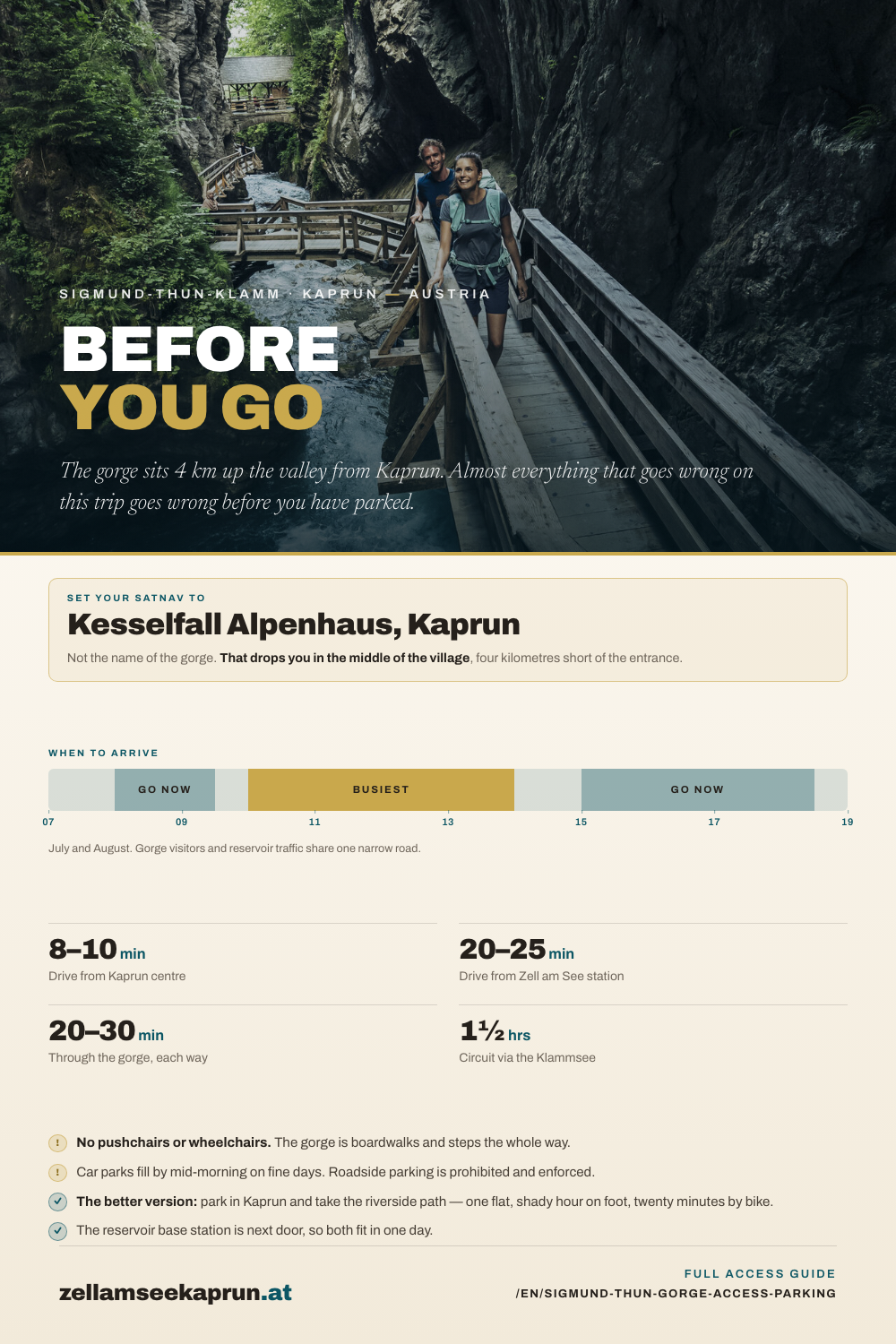
Drive up the Kesselfallstrasse to the Kesselfall Alpenhaus in Kaprun and park there for a charge (often full by mid-morning in summer), or walk about an hour from the centre of Kaprun or cycle it in 20 minutes. Through the gorge takes 20 to 30 minutes per direction, and the circuit via the Klammsee around an hour and a half. Pushchairs and wheelchairs are not possible because of several hundred steps, but a carrier is fine; the Klammsee is also reachable with a pushchair via the forest track. Season roughly May to early October, with times and prices to be checked with the operator beforehand.
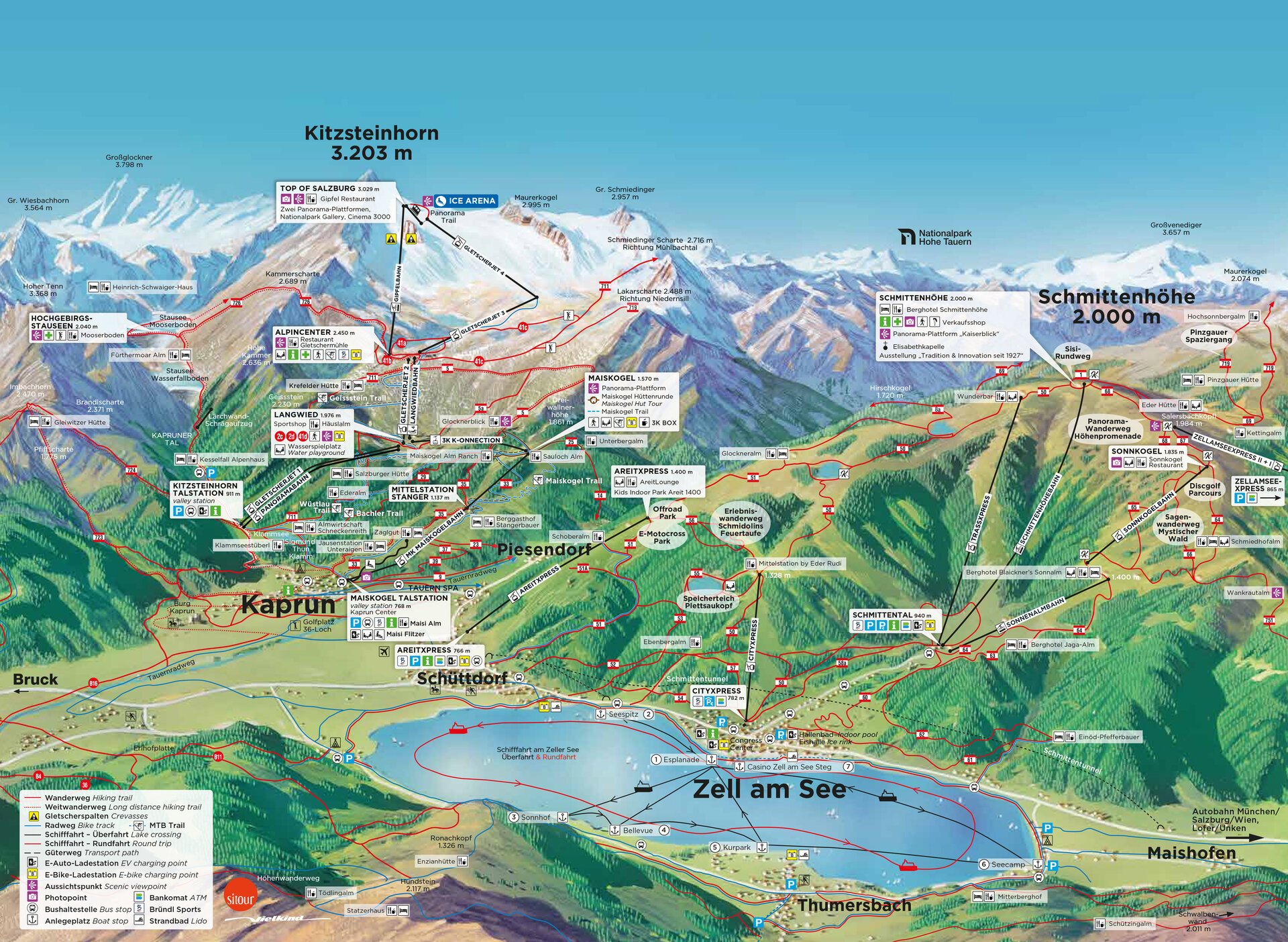
Briefly and practically first: the Sigmund Thun Gorge lies at the southern end of Kaprun, around four kilometres from the village centre. You drive up the Kesselfallstrasse towards the Kesselfall Alpenhaus, leave the car on one of the managed car parks and walk a few minutes from there to the gorge entrance. For the gorge itself allow around 20 to 30 minutes per direction, and about an hour and a half for the circuit via the Klammsee. Pushchairs and wheelchairs cannot get through the gorge; the honest answer and an alternative follow below. If you are heading up to the high mountain reservoirs anyway, combine both on the same day, because the base station is practically next door.
Driving there: where exactly to navigate to
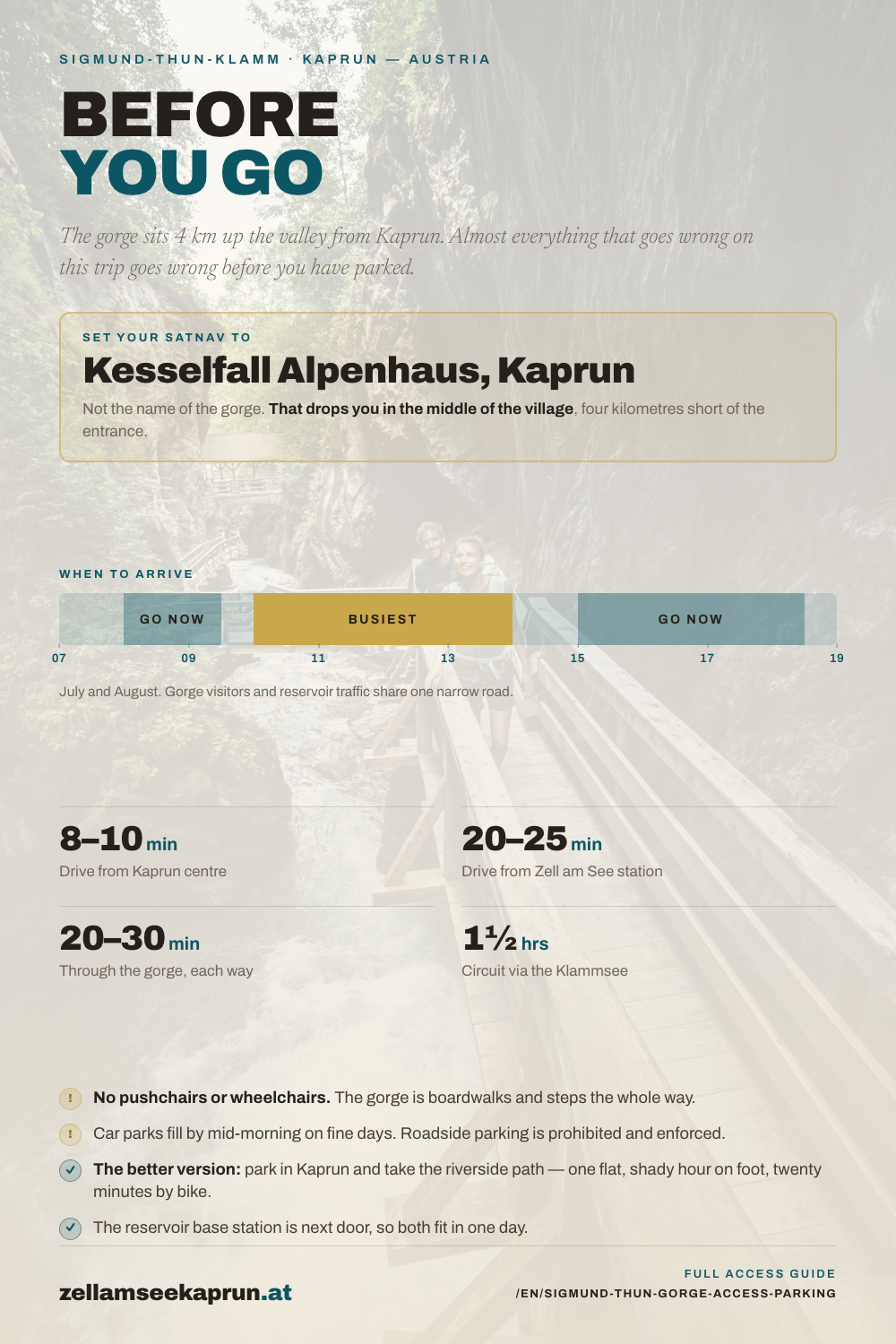
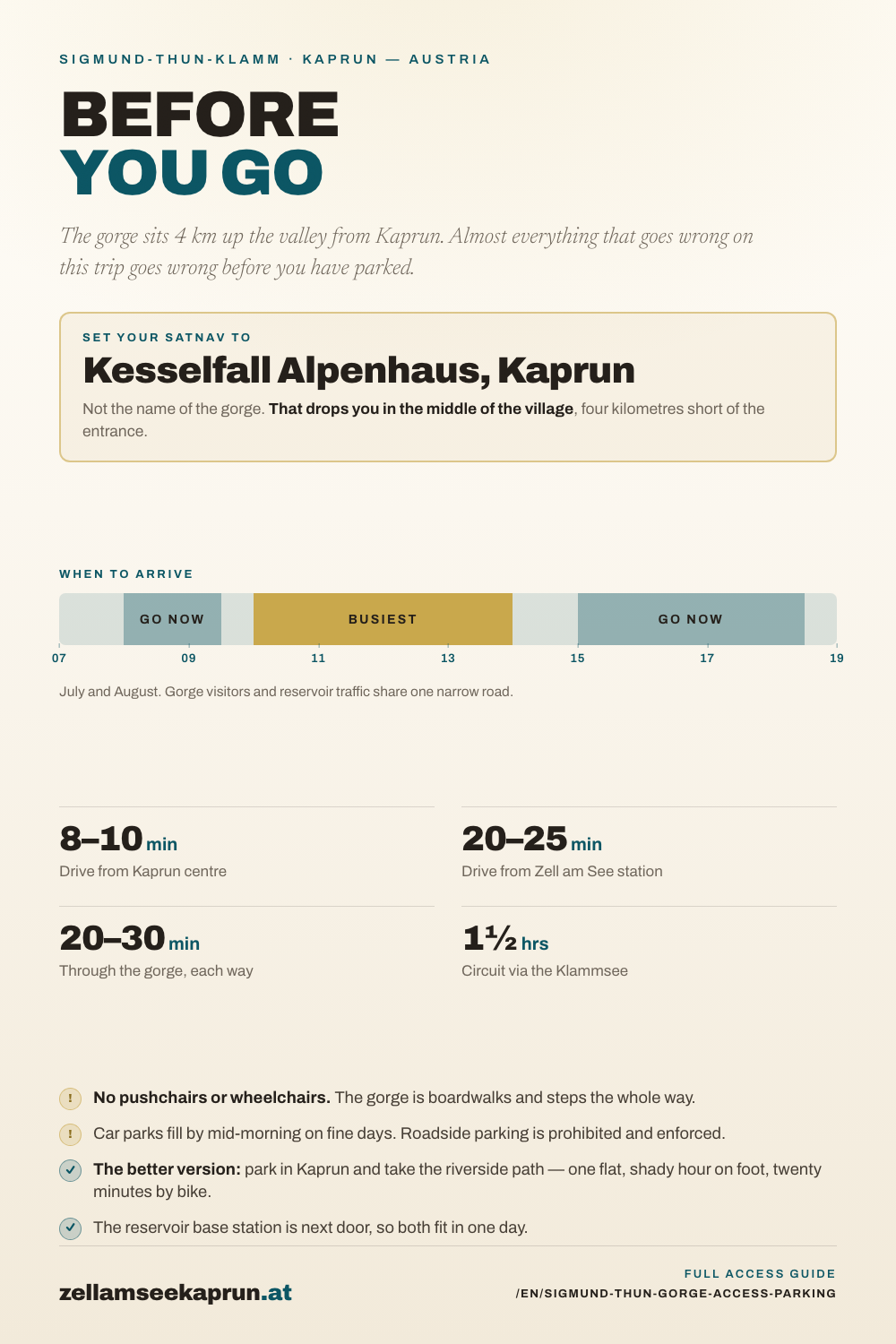
The most common mistake is simply entering the name of the gorge into the satnav and then standing somewhere in the middle of the village. It is more effective to set the destination as Kesselfall Alpenhaus, Kaprun, or simply the Kesselfallstrasse. From the centre of Kaprun you drive past the power station site and continue up the valley; the road follows the Kaprun stream and ends after a few kilometres at the Alpenhaus. Pure driving time from the centre of Kaprun is about eight to ten minutes.
From Zell am See allow around 20 to 25 minutes from the station, and from Bruck an der Glocknerstrasse about 20 minutes. If you are arriving via the Grossglockner High Alpine Road, put the gorge on a separate half-day, as both in one day makes for a very long day in the car.
The approach is a normal surfaced municipal road, but narrow in summer and sluggish from late morning. In the July and August peak the busiest period is roughly between ten and two, because gorge visitors and reservoir day-trippers share the same stretch of road. Come between eight and half past nine, or after three, and you spare yourself the search.
Parking at the Kesselfall, and the more relaxed alternative
At the end of the Kesselfallstrasse there are several managed parking areas around the Kesselfall Alpenhaus. They are chargeable; as a rough guide for the 2026 season expect a daily rate in the low to middle single-digit euro range. That is deliberately phrased as an approximation, since tariffs and payment arrangements change, so please check briefly with the operator or the signage on site before relying on a figure.
Worth knowing: on fine summer days these car parks are regularly full by mid-morning. There is then no improvised alternative, as parking at the roadside is prohibited and enforced, because emergency vehicles and the reservoir buses have to get through.
The more relaxed option: park in the centre of Kaprun, where there are larger parking areas and short-stay zones, and cover the last kilometres on foot or by bike. The path along the Kaprun stream is flat, shady and attractive, around an hour on foot or about twenty minutes by bike. If you enjoy walking anyway, that makes the better version of the excursion and saves the parking hunt entirely.
Without a car: local bus, cycle path and the last stage
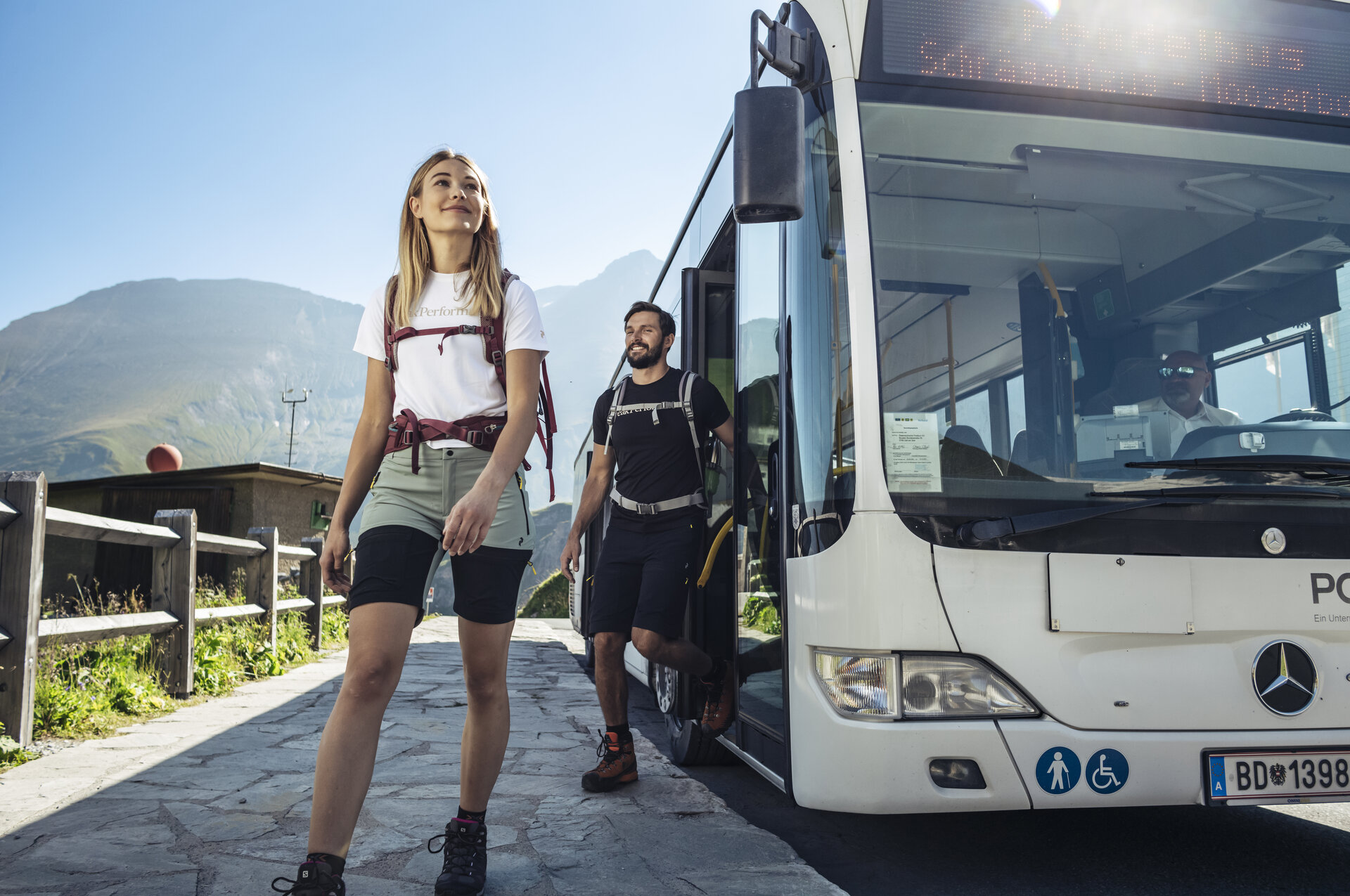
Kaprun is well connected to public transport. Regional buses run from Zell am See station to Kaprun, and within the village a local bus takes you towards the Kesselfall Alpenhaus. In the summer season it runs considerably more frequently than in the low season; timetables, operating days and the final stop change seasonally, so no times are given here. Check the current timetable the day before or ask at your accommodation.
Guests with a valid regional guest card travel on the local lines at no extra charge in many cases. That too is something that can change from season to season, so a quick question at reception pays off.
The cycle path from Zell am See to Kaprun and further up the valley is one of the most pleasant approaches of all: almost entirely flat, away from the road, around nine kilometres from Zell am See. E-bike hire is available in both places. There are bike racks at the gorge entrance; the gorge itself may of course only be walked.
Walking time and path profile
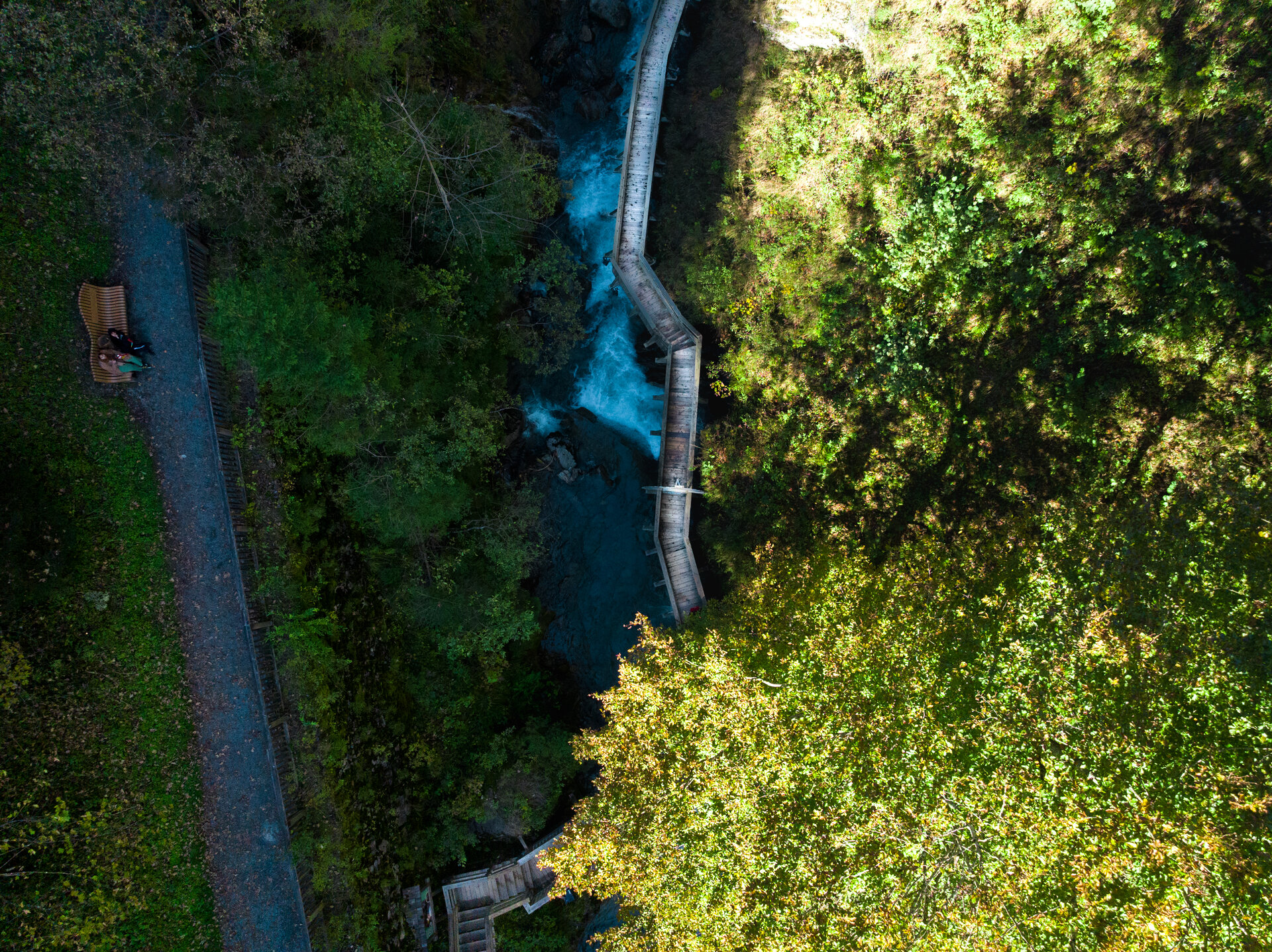
The gorge is about 320 metres long, and in places the rock walls close in a good 30 metres above you. The path runs over wooden walkways, narrow steel bridges and several hundred steps, partly tight, partly damp, and always loud with the water of the Kaprun stream.
- Through the gorge only, one way: 20 to 30 minutes, or 40 with photo stops.
- Up through the gorge and back the same way: about an hour. It gets sluggish with oncoming traffic on the walkways, so this is not the most elegant solution.
- The classic circuit: up through the gorge to the Klammsee, around the lake and back via the wider forest track, around an hour and a half without breaks.
- From the centre of Kaprun on foot, there and back including the gorge: three to three and a half hours.
- With small children and a picnic at the Klammsee: allow a generous half-day.
None of it is technically difficult, but you still need sure footing. The steps are slippery when wet, and wet is the normal state in a gorge. Sturdy shoes with a profiled sole rather than sandals, plus a thin jacket, since inside the ravine it is noticeably cooler than outside even in high summer.
Pushchairs and accessibility: the honest answer
No. The Sigmund Thun Gorge cannot be negotiated with a pushchair and is not accessible for wheelchair users. That is not a question of motivation but of construction: several hundred steps, tight turns on the walkways, very narrow in stretches and with no room to pass. Even a sporty buggy will not get through, and carrying one over the steps is not a good idea on wet wooden planks.
With a baby or toddler: a carrier. The gorge is perfectly manageable that way and many families do exactly that. Very small children do sometimes react sensitively to the noise, though, because it really is loud in there.
With a pushchair or limited mobility: you can also reach the Klammsee via the broad forest track that bypasses the gorge. It climbs evenly, is gravelled and passable with a sturdy pushchair; for wheelchairs it is borderline depending on the model, your companions and the surface, because the gradient and gravel are demanding. The Klammsee itself, with its green water and benches on the shore, is a rewarding destination in its own right, and many guests find it even more photogenic than the ravine.
Dogs are usually allowed on a short lead but often struggle on the metal gratings. Check the current rule on site, as it can change.
Season, opening times and admission
The gorge is a summer destination. It usually opens in late spring, as soon as the thaw and maintenance work allow, and closes again in autumn; as a rough frame, about May to early October. In January or February you will stand in front of a closed gate, which is the most common disappointment among winter guests. Winter visitors will find alternatives in our bad-weather overview for the region.
The ticket office is staffed during the day, for longer in peak season than in the shoulder season. On admission, expect a guide value in the middle single-digit euro range for adults with a reduced child and family rate. Deliberately no fixed amount, since prices are adjusted each season and a wrong euro figure online helps nobody. Check opening times and tariffs on your travel day with the operator or Kaprun tourist board, especially early or late in the season and after heavy rain. In storms or high water the gorge is closed at short notice, and for good reason.
Combining the gorge and the reservoirs in one day
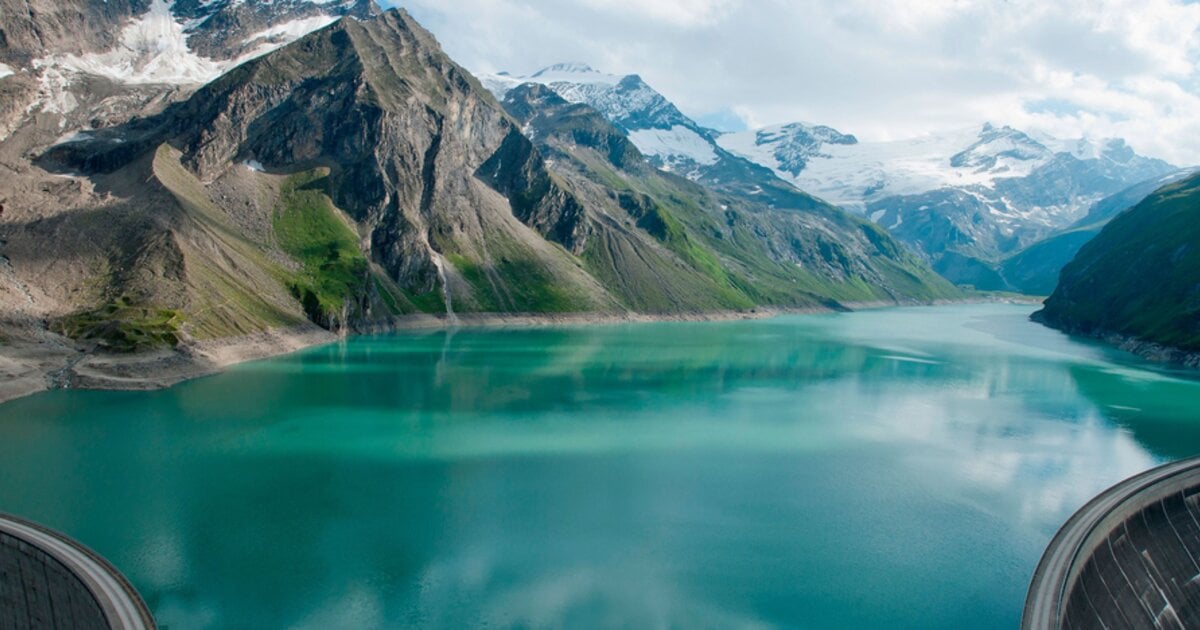
This is the smartest day plan in the Kaprun valley, because both destinations share the same starting point. The buses and the Laerchwand inclined lift up to the high mountain reservoirs at around 2,040 metres depart from the Kesselfall Alpenhaus, so you are standing where the gorge begins anyway.
Proven order: arrive early, walk the gorge first while it is still empty and the light in the ravine is good, then return to the Alpenhaus and head up to the Mooserboden at midday. The reverse works too, but you will have more company in the gorge in the afternoon. For the ascent to the reservoirs allow at least four hours including waiting, changes and a relaxed stay at the top, so reckon on a full day for both and leave the glacier out that day. Details in the reservoirs access guide.
The glacier on the Kitzsteinhorn at 3,029 metres is a chapter of its own and deserves its own day. If you want something quiet after the gorge, Kaprun Castle in the village serves well. For the big picture of everything the valley offers, our Kaprun travel guide helps further. And for how the gorge itself feels — the walkways, the water, the play of light — read the article on hiking through the water gorge.
Small things that make the trip better
Take cash: card payment is not guaranteed at small ticket offices and parking machines in the mountains. Mobile reception in the ravine is poor in places, so download timetables beforehand. At the Kesselfall Alpenhaus and around the Klammsee there are places to eat of classic inn quality, and if you prefer your own picnic there are benches with a view on the lakeshore.
One tip from experience to finish: after a heavy day of rain the Kaprun stream carries a lot of water and the gorge is particularly impressive, provided it is open. A quick look at the operator page in the morning saves a wasted journey.
Frequently Asked Questions
Where do you park for the Sigmund Thun Gorge?
On the managed parking areas at the end of the Kesselfallstrasse by the Kesselfall Alpenhaus, a few minutes on foot from the gorge entrance. The spaces are chargeable and in July and August frequently full from late morning. Alternative: park in the centre of Kaprun and cover the last kilometres along the Kaprun stream on foot (around an hour) or by bike (about 20 minutes). Parking at the roadside is not permitted.
How long does the Sigmund Thun Gorge take?
For the roughly 320 metre long gorge allow 20 to 30 minutes per direction. The classic circuit up through the gorge to the Klammsee and back via the forest track takes about an hour and a half. On foot from the centre of Kaprun and back, including the gorge, allow three to three and a half hours.
Is the gorge manageable with a pushchair or wheelchair?
No. Several hundred steps plus narrow wooden walkways and steel bridges make the gorge impassable for pushchairs and wheelchairs. With a baby a carrier works well. If you cannot go through the gorge, you can reach the Klammsee via the wider forest track, which climbs evenly and is passable with a sturdy pushchair; for wheelchairs it is borderline because of the gradient and gravel.
When is the Sigmund Thun Gorge open?
The gorge is a summer destination and usually walkable from about May to early October, depending on snow and maintenance. In winter it is closed. In storms or high water it is closed at short notice. Please check opening times and admission on your travel day with the operator or Kaprun tourist board rather than relying on figures online.
Can you get to the gorge without a car?
Yes. Regional buses run from Zell am See station to Kaprun, and a local bus runs in the village towards the Kesselfall Alpenhaus, considerably more frequently in summer than in the low season. Guests with a regional guest card often travel at no extra charge. The flat, largely traffic-free cycle path from Zell am See to Kaprun and further up the valley is also very pleasant.
Can the gorge be combined with the high mountain reservoirs?
Yes, and that is the most efficient day plan, because both start at the Kesselfall Alpenhaus. Proven approach: arrive early, walk the gorge first, then take the bus and the Laerchwand inclined lift up to the Mooserboden at around 2,040 metres. For the reservoirs alone allow at least four hours including changes and time at the top, so together that makes a full day.