
Key facts at a glance
Hohensalzburg is one of the largest fully preserved castles in Europe and was never taken. You get up on foot in about twenty minutes or by funicular in one. The Salzburg Card pays off not automatically but from around three paid attractions in a day.
In short: Hohensalzburg is one of the largest fully preserved castles in Europe and the point at which almost every visit to Salzburg begins or ends. You get up on foot in around twenty minutes, or on the Festungsbahn funicular in one. The Salzburg Card does not pay off automatically but from about three paid attractions in a day — this page works that through.
Transparency notice: this article contains advertising links to GetYourGuide. If you book through them we receive a small commission — the price stays exactly the same for you.
Why the castle is still standing
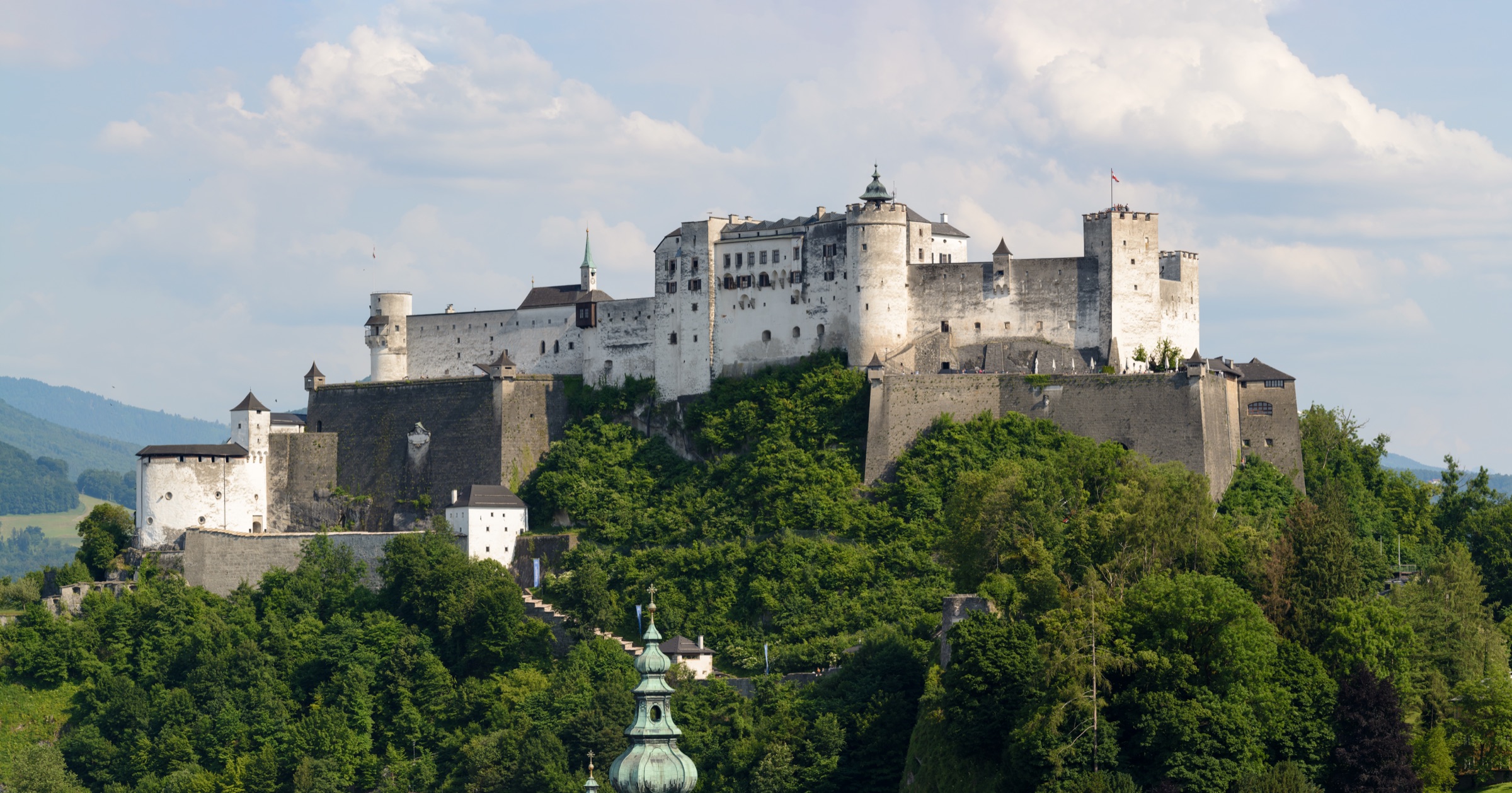
Hohensalzburg was begun in 1077 under Archbishop Gebhard and extended over centuries, taking most of its present shape around 1500 under Leonhard von Keutschach. It stands on the Festungsberg, a little over 500 metres above sea level and some 120 metres above the old town.
The reason for its condition is unspectacular and therefore remarkable: the fortress was never taken. It was besieged once, in the peasants’ revolt of 1525 — and even that failed. What you see is not reconstruction but accumulated fabric.
Getting up: on foot or by funicular
The Festungsbahn is a funicular from Festungsgasse by Kapitelplatz. The ride takes about a minute. It is included in most combination tickets and in the Salzburg Card. On busy summer days and around the festival the queue at the lower station builds noticeably — a timed ticket removes that.
On foot you take the Festungsweg, around twenty minutes of steady climbing on cobbles. Perfectly manageable and free, but sweaty in high summer. A proven compromise: up by funicular, down on foot over the Mönchsberg — that path is the more attractive stretch and is usually overlooked.
Check availability & priceWhat you see up there
- The state rooms — late Gothic interiors from around 1500, the real core of the visit and considerably more impressive than the term suggests.
- The fortress museum on building and military history, plus the marionette museum.
- The Reckturm with its panorama over the city, the Salzach valley and, in clear weather, as far as the main Alpine ridge.
- The Salzburg Bull, a mechanical organ of 1502 that is still played.
Allow an hour and a half to two hours for the full circuit, less if you only want the view. The audio guide is usually included and is decent.
On accessibility: the funicular gets you up comfortably, but the castle itself is a medieval structure with steps, thresholds and narrow spiral staircases. The courtyard and the viewing terraces are reachable; the state rooms and the Reckturm only partly.
The Salzburg Card, worked through honestly
The card comes in 24, 48 and 72-hour versions. It covers one entry to most attractions — fortress including funicular, Mozart’s birthplace and residence, Hellbrunn, museums — plus public transport in the city.
Check availability & priceThe rule of thumb: from about three paid attractions in a day the card works out. Below that it does not.
- Worth it: fortress with funicular, plus Mozart’s birthplace and Hellbrunn, plus bus journeys. A dense, plannable day.
- Not worth it: if you want to see the fortress and then sit in a coffee house, single tickets cost less.
- Note for day visitors from Zell am See: the 24-hour card runs from validation, not by calendar day. Arriving around 10am and heading back at 6pm uses eight of the 24 hours, and the card has to pay for itself in that window.
- The transport element is of little use if you drive and park in an old town garage anyway.
Put differently: for a day trip from Zell am See the Salzburg Card is only right if you are planning a full day of sightseeing. For half a day with a guided walk and the fortress, single tickets are enough.
The fortress in the evening
The finest way to experience the castle is not the daytime visit but a fortress concert. You ride up in the dark, hear around an hour and a half of chamber music in the Golden Hall, and look down over the lit city. Optionally with dinner in the fortress restaurant beforehand.
Best of Mozart: Festungskonzert
Check availability & priceBest of Mozart: Festungskonzert mit Abendessen
Check availability & priceIf you plan that, think about the journey back to Zell am See — the last train connections run earlier than most people assume. For concert evenings an overnight stay in Salzburg is usually the more sensible decision.
Practicalities
- Best time: early morning or from late afternoon. Between 11am and 3pm the castle is busy in summer.
- Weather: the Reckturm is pointless under low cloud, but the interiors still repay a visit — which makes the fortress a usable bad-weather option.
- With children: the marionette museum and the ramparts work well; the state rooms less so.
All the other tours and tickets: Salzburg tours from Zell am See.
Frequently Asked Questions
How do you get up to Hohensalzburg Fortress?
By the Festungsbahn funicular from Festungsgasse near Kapitelplatz, in about a minute, which is included in most combination tickets and in the Salzburg Card. Or on foot up the Festungsweg in around twenty minutes of steady climbing. A good compromise is up by funicular and down on foot over the Mönchsberg.
When does the Salzburg Card pay off?
As a rule of thumb from about three paid attractions in a day, for instance the fortress with its funicular, Mozart's birthplace and Hellbrunn, plus bus journeys. If you only want to see the fortress, single tickets cost less.
Does the Salzburg Card run by calendar day?
No, the 24-hour card runs from validation. That matters for day visitors from Zell am See: arriving around 10am and heading back at 6pm uses eight of the 24 hours, and the card has to pay for itself within that window.
How long do you need at the fortress?
An hour and a half to two hours for the full circuit with the state rooms, the fortress museum and the Reckturm, and considerably less if you only want the view. It is quietest early in the morning or from late afternoon; between 11am and 3pm it is busy in summer.
Is the fortress accessible?
Only partly. The funicular gets you up comfortably and the courtyard and viewing terraces are reachable, but the castle is a medieval structure with steps, thresholds and narrow spiral staircases, so the state rooms and the Reckturm are only partly accessible.